
That confusion is exactly why this category is getting attention across U.S. hospitality, gaming, and entertainment venues right now. Operators are watching queues stack up during rushes, recipes drift between shifts, and labor costs climb — and they're looking for a fix.
The problems driving interest are familiar to anyone who's run a bar:
- Long waits during peak periods (concerts, casino floors, stadium concourses)
- Inconsistent pours between bartenders and shifts
- Labor shortages and rising wages
- Over-pouring, spillage, and shrinkage
- Limited service windows (intermission, last call, event start times)
This article breaks down what these systems actually are, how they work, what they can realistically deliver, and what responsibilities never go away — no matter how automated the pour.
Key Takeaways
- "AI bartender" means three technologies: recipe-chat software, robotic-arm systems, and automated dispensers—not one category.
- Automation improves speed, consistency, and inventory visibility; it does not replace responsible alcohol service.
- Match the system to your volume, menu, staffing, and floor space, not the flashiest demo.
- Compare total operating costs, sanitation needs, and vendor support before you sign.
What Is an AI Robot Bartender?
Three Technologies Get Lumped Into One Term
The phrase "AI robot bartender" gets applied loosely. In practice, it usually means one of three things:
- Conversational AI bartenders — software that recommends recipes, answers questions, and personalizes suggestions based on available spirits and mixers. No hardware, no pouring.
- Robotic bartenders — physical machinery like robotic arms or countertop devices that combine some mix of preparation, dispensing, and customer interaction. Makr Shakr's choreographed robot arms are the best-known example.
- Automated cocktail dispensers — systems using programmed recipes and precision controls to pour consistent drinks. These don't converse or improvise; they execute.
That third category is where most commercial hospitality investment actually happens, because it solves a measurable operational problem instead of just adding novelty.

What the Customer Experience Looks Like
A typical order moves through a short sequence:
- Menu selection via touchscreen, QR code, or app
- Payment and age verification
- Measured dispensing
- Garnish or handoff
Some systems only pour preconfigured drinks. Others connect to POS platforms, support remote ordering, or run a branded digital interface guests use directly.
Where Smartender Fits
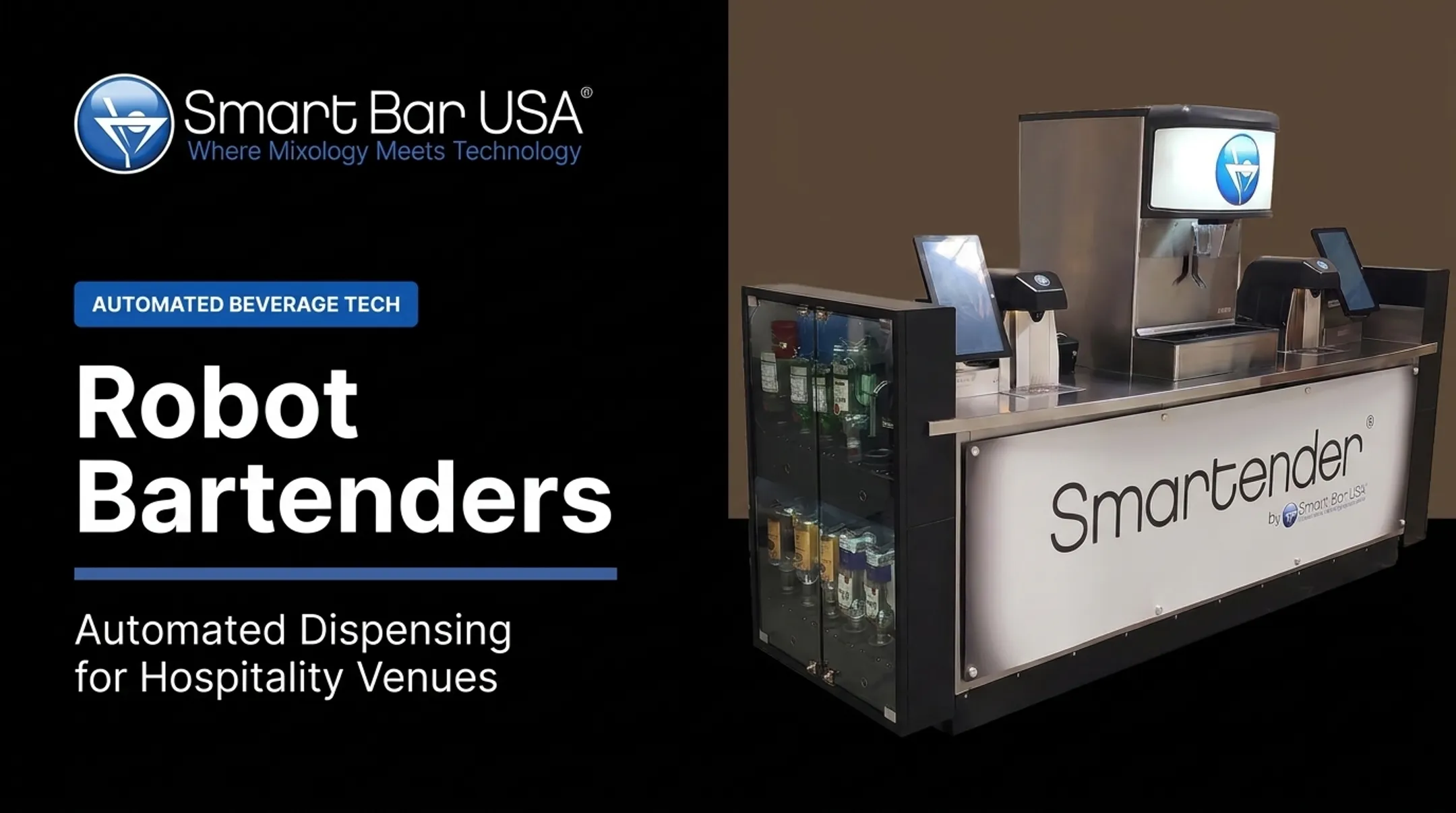
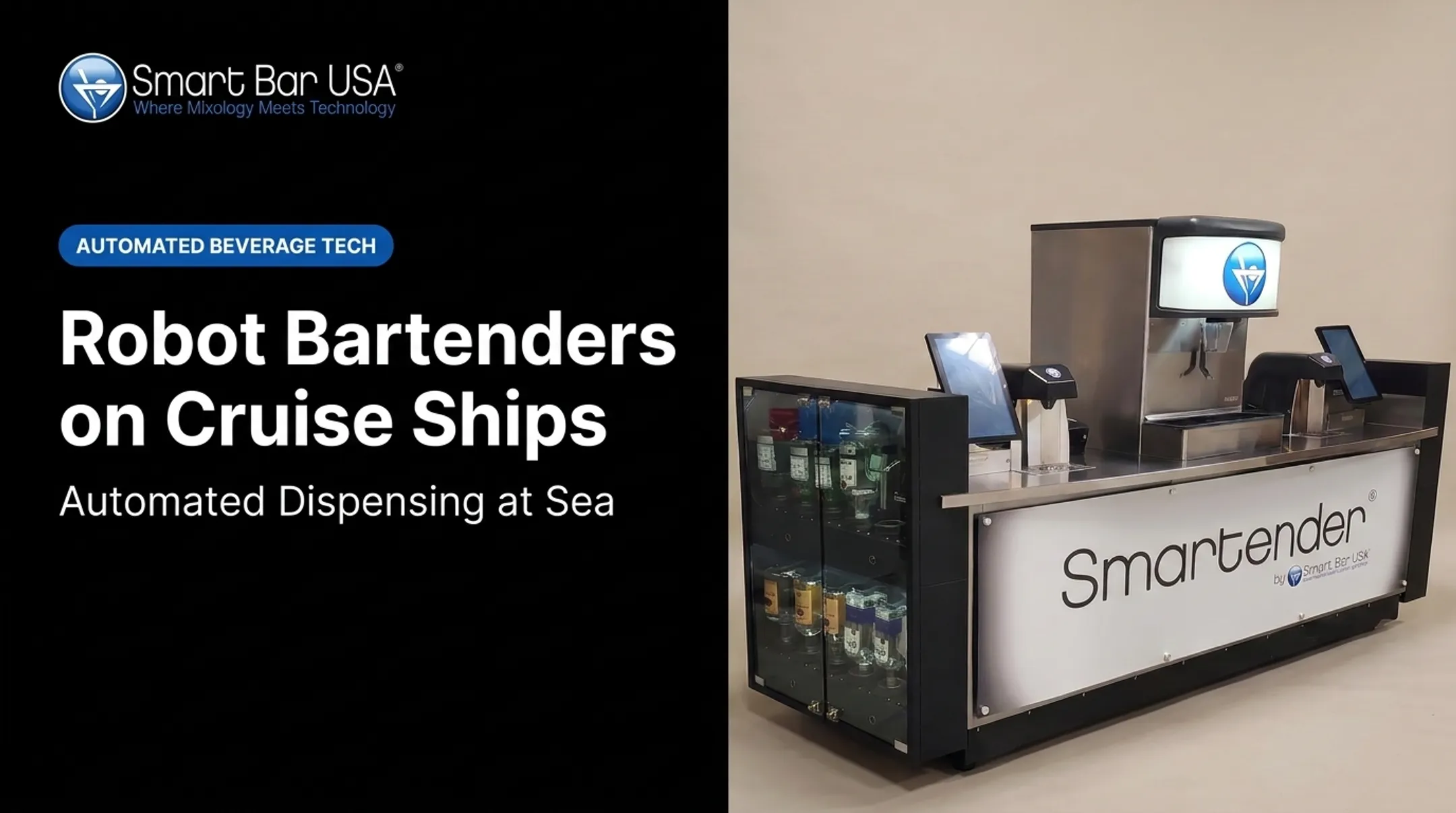
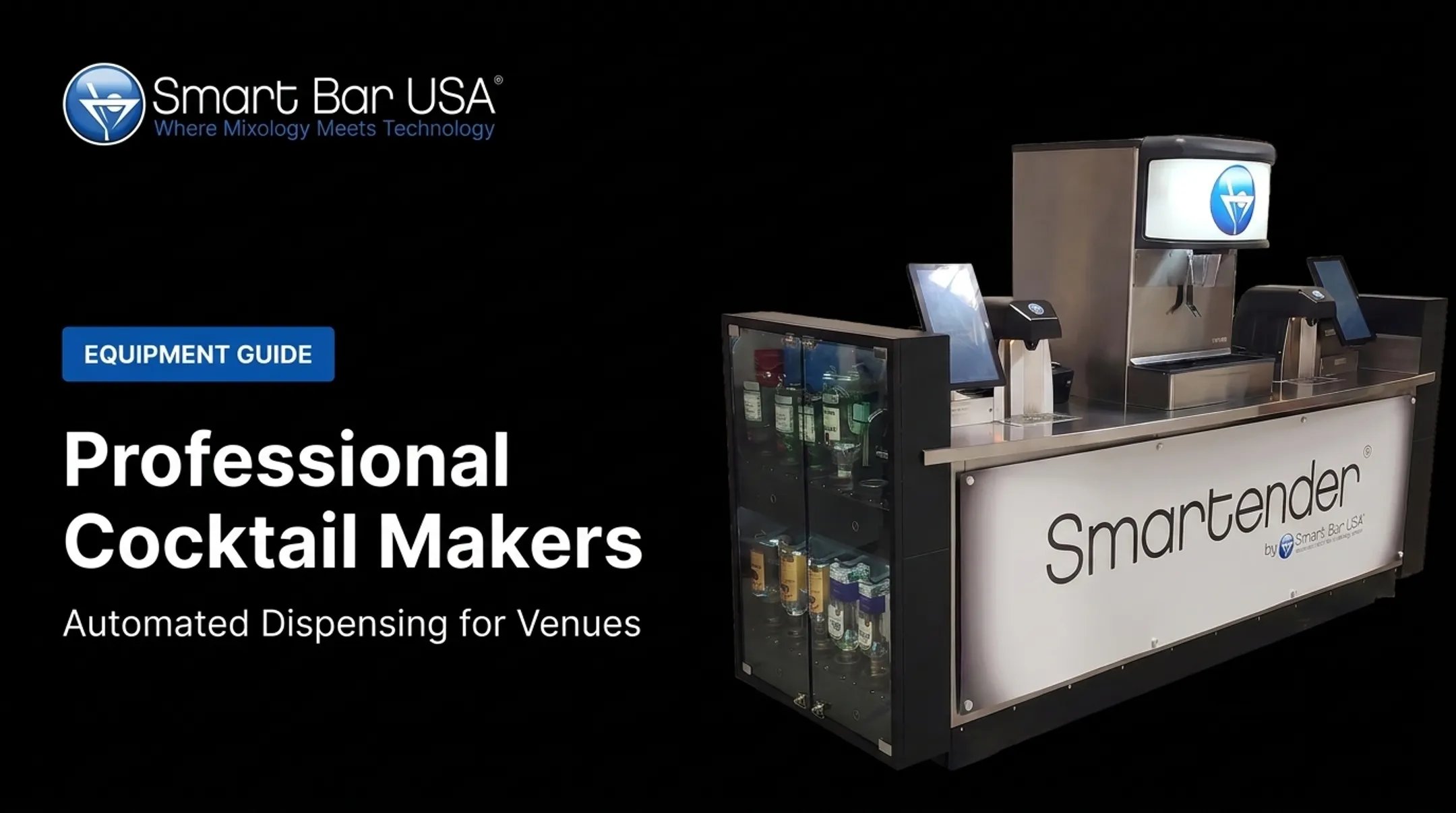
Smart Bar USA, a Las Vegas-based manufacturer founded in 2012, makes the Smartender family of automated cocktail dispensers for casinos, hotels, stadiums, and entertainment venues. Smart Bar USA does not label these systems as "robot bartenders." They are beverage automation: programmed, precision dispensing equipment, not autonomous decision-making machines.
How Do AI Robot Bartenders Work?
Ordering and Interaction
Orders reach the machine through several channels:
- Touchscreen at the unit
- Venue POS system
- Kiosk or mobile app
- QR code ordering
Smart Bar USA's Smartender QR ordering, for example, routes tickets through the venue POS for automatic pouring and garnishing, then flags a server for delivery. When a system also collects payment info, ID data, or personalization preferences, privacy handling becomes part of the setup.
Recipe Configuration, Not Improvisation
Operators program ratios, portion sizes, modifiers, and menu availability into the system. At Bad to the Bones Sports Bar, staff locked in recipes to guarantee consistency across shifts. At 888 Japanese BBQ, one operator spent nearly two weeks calibrating recipes because thick juices and CO2-driven sodas introduced variability that needed manual tuning.
This is the key point: the machine doesn't improvise cocktails. It executes what's been configured, which is exactly why consistency improves.
Dispensing Mechanics
The basic workflow: digital order → recipe lookup → pump-driven measured pour from ingredient lines → glass positioning → handoff. Smart Bar USA's A-Series documentation claims:
- Pours averaging 4 seconds per drink
- Accuracy within 1/16th of an ounce
- Capacity for 8 to 50 distinct liquors, depending on model (A800 through A5000)

Treat these as vendor specifications, not industry-wide benchmarks. Other manufacturers, such as Brewmac and Easybar, publish their own numbers under their own test conditions.
Payments, Age Verification, and Service Controls
This is where automation gets misunderstood. Systems can integrate POS payment authorization and QR-based order verification, but age verification and legal compliance remain human and jurisdiction-specific responsibilities.
The Alcohol and Tobacco Tax and Trade Bureau confirms it doesn't enforce state and local retail-service laws. That duty falls to state alcohol authorities, and requirements vary by state.
Smartender self-service configurations, for example, support alcohol-service schedules that restrict access by date and time, plus QR/barcode scanning that retrieves pre-authorized orders. An ID check, staff approval, or cashier verification still typically happens before that authorization is issued, not instead of it.
Monitoring and Maintenance
Pour records, ingredient-usage data, and alerts support inventory control. But every system still needs trained staff for refills, cleaning cycles, calibration checks, and a documented fallback procedure for when the machine or payment system goes down.
What Are the Benefits of AI Robot Bartenders?
Faster Service During Demand Spikes
Automated dispensing shines when queues get long. A 2021 Sports Business Journal report attributed a 9-12 minute conventional stadium wait time versus roughly 14 drinks per minute from an automated bar setup, though that figure came from a company co-founder rather than an independent study.
Use it as a benchmark to test at your own venue, not a guaranteed result.
Atomic Golf in Las Vegas offers a more grounded example: four Smartender systems integrated with GoTab's ordering platform, supporting up to 100 golf bays and peak capacity over 3,200 guests, reportedly reaching combined output up to 1,440 drinks per hour across the installation.

More Consistent Recipes
Programmed recipes and controlled measurements reduce variation between bartenders and shifts. Smart Bar USA's published claims (sub-4-second pours, 1/16-ounce precision) are Smartender-specific product figures, not universal standards for every dispenser on the market.
Better Allocation of Staff
The strongest operational model doesn't eliminate bartenders. It shifts them toward:
- Guest interaction and hospitality
- ID checks and responsible-service monitoring
- Garnishing and finishing touches
- Problem resolution
Smart Bar USA frames automation as the engine for repetitive drink production so staff can focus on higher-value work. It is not marketed or legally positioned as a way to run an unattended bar.
Lower Waste, Better Inventory Visibility
Measured pours paired with digital tracking can reduce over-pours and unexplained inventory variance. At 888 Japanese BBQ, an A1800 unit was tied to reduced waste and improved staff efficiency. Baseline your own shrinkage numbers before and after a pilot so you can measure the real impact.
Flexible Service Formats
Portable, modular, chilled, and self-service formats support different layouts:
- Smartender GO — fully self-contained, portable, built for pop-ups and events
- Smartender CHILL — refrigerated, rated over 300 drinks/hour
- Smartender DUO — twin-head self-serve station with touchscreen and QR ordering
Match the format to your service window and layout, then model equipment, ingredient, and staffing costs against expected throughput before you lock in a rollout.
What Risks and Responsibilities Should Operators Consider?
Responsible Alcohol Service Doesn't Disappear
Precise pouring says nothing about whether a guest has had too much to drink. Intervention, pacing, and refusal still sit with a trained employee or supervisor.
Dram-shop liability is real. A Community Preventive Services Task Force review found liability exposure associated with a median 6.4% reduction in alcohol-related crash deaths. Rules vary by state, so confirm your liquor-liability requirements before you deploy.
Age Verification and Access Control
Self-service formats raise legitimate concerns: fake IDs, minors accessing kiosks, shared payment credentials, or an approved guest ordering for someone underage. Smartender's self-serve workflow typically requires a cashier-verified ID check before a QR code or receipt is issued. The system authorizes the pour only after that human check. Useful controls include:
- Staff-supervised access points
- Payment-linked authorization
- Time-and-date service restrictions
- Audit logs of every transaction

Equipment Safety and System Failure
Ingredient lines, reservoirs, and dispensing points need protection from contamination, especially in crowded self-service settings. Build these controls in from day one:
- Emergency shutoffs at the unit and circuit level
- Spill containment around dispense points
- A documented manual fallback when connectivity or power drops
Data Privacy
Any system collecting payment data, ID information, or personalization profiles needs to handle that responsibly. California's CCPA treats biometric and payment data as sensitive personal information with specific consumer rights. Illinois' BIPA requires written consent before collecting biometric identifiers such as facial geometry.
Before you add facial recognition or personalization, confirm data retention policies, consent processes, and vendor access controls.
Sanitation and Allergens
Line cleaning, food-contact surfaces, and cross-contamination prevention need documented procedures. Smart Bar USA's equipment carries ETL certifications, but operators still need to validate that a machine handles their menu safely under real service conditions. Thick juices, carbonation, and perishables all behave differently than clear spirits.
Human Hospitality Still Matters
Some guests still want a human bartender for conversation, recommendations, and conflict resolution. Automation speeds up production; hospitality is what brings people back. Keep visible staff involved and gather guest feedback on service quality, not pour speed alone.
How Should a Venue Evaluate This Technology?
Match the System to Your Operating Model
Before picking hardware, get clear on the actual goal:
- Faster dispensing during a rush
- Labor redeployment
- Inventory control and shrinkage reduction
- A branded attraction
A 24/7 casino floor has different needs than a pop-up event bar. MGM National Harbor deployed 10 Smartender A3400 units across high-traffic casino bars; Hard Rock Casino Rockford installed nine A5000 units on its 24/7 floor. Different scale, same underlying logic: match capacity to actual peak demand.
Vendor Due Diligence Checklist
- POS and payment integration
- Age-verification workflow and compliance controls
- Ingredient capacity and menu flexibility
- Sanitation certifications (ETL, NSF, or equivalent)
- Training, warranty, and service response times
- Failover plans for power, refrigeration, or connectivity loss
Ask for live demonstrations and references from comparable venues. Pearl River Resort & Casino ran a year-long trial before expanding with six additional Modular units. Push for that kind of validation period.
Pilot First, Then Build the Business Case
Establish baseline numbers before installing anything:
- Wait times
- Labor hours
- Waste percentage
- Inventory variance
- Guest satisfaction
Compare those figures against pilot results over a defined period. Model total costs with actual vendor quotes rather than assumed savings: purchase or financing, installation, consumables, cleaning, software, training, and insurance.
Frequently Asked Questions
Is there a free version of an AI bartender?
Free recipe-chat tools exist, but commercial robotic and dispensing hardware isn't free. It's a capital investment sold through vendor demos and quotes. If you're using a free app, review its privacy terms and recipe accuracy before relying on it.
What is an AI robot bartender?
An AI robot bartender is a broad term covering conversational AI software, physical robotic systems, and automated cocktail dispensers. These have very different capabilities, so don't assume one label means the same thing across vendors.
How does an AI robot bartender work?
Orders come in through a touchscreen, POS, or app; the system checks payment and age-verification status, then pours a pre-programmed recipe with measured accuracy. Staff still handle oversight, inventory tracking, and cleaning.
Can an AI robot bartender replace a human bartender?
It can reduce repetitive pouring tasks and increase throughput during rushes, but it can't make responsible-service judgment calls, provide hospitality, or resolve guest issues. Staff roles shift; they don't disappear.
Are AI robot bartenders safe for serving alcohol?
Safety depends on the controls built around the machine: age verification, staff monitoring, sanitation procedures, and compliance with your state's alcohol laws. The equipment supports these processes; it doesn't replace them.
How much does an AI robot bartender cost?
Costs vary widely by hardware type, liquor capacity, installation, and software integration. Vendors like Smart Bar USA sell direct with demo-driven pricing, so get comparable quotes from multiple manufacturers before committing.